
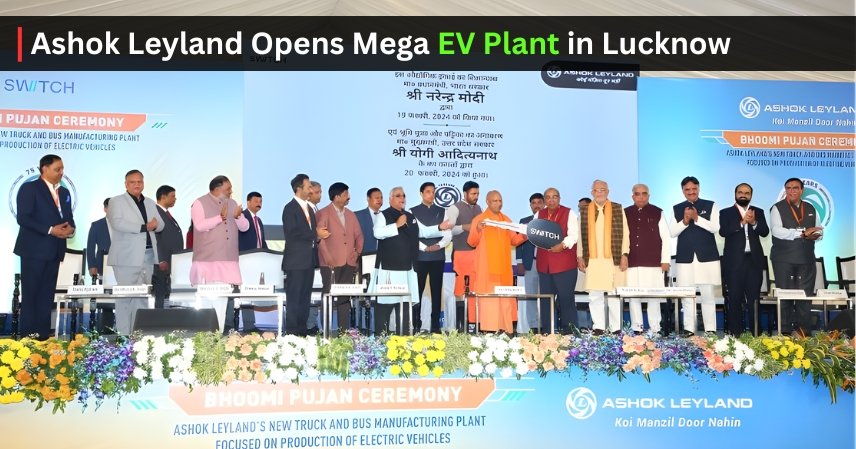
Ashok Leyland’s state-of-the-art electric vehicle (EV) plant in Lucknow, Uttar Pradesh, marks a significant leap forward for India’s electric mobility sector. Officially inaugurated on January 9, 2026, this facility aligns with the company’s vision for cleaner transportation, sustainable production, and robust economic development in the region. Its launch positions Uttar Pradesh as a rapidly emerging hub for electric commercial vehicles—particularly electric buses that are vital for India’s push toward electrified public transport.
Inauguration Ceremony: Dignitaries in Attendance
The launch event underscored the project’s national importance, with several prominent leaders present:
- Yogi Adityanath – Chief Minister of Uttar Pradesh
- Rajnath Singh – India’s Defence Minister and MP from Lucknow
- H. D. Kumaraswamy – Union Minister for Heavy Industries
Their attendance reflects strong governmental support for Ashok Leyland’s role in driving India’s transition to electric mobility.
Facility Overview: A 70-Acre Integrated EV Manufacturing Hub
Located in the Sarojini Nagar Industrial Area near Lucknow airport, the new plant spans 70 acres. Designed as a fully integrated manufacturing center, its primary focus is on producing electric commercial vehicles, with a special emphasis on buses.
Production Capacity and Expansion Plans
- Initial Capacity: 2,500 electric vehicles in the first year
- Planned Expansion: Up to 5,000 units annually, in phased steps
This growth strategy is tailored to meet India’s increasing demand for electric buses and supports the country’s clean public transportation goals.
Focus on Electric Buses and Sustainable Transport
The Lucknow plant’s main output will be electric buses—a crucial solution for urban, school, and intercity transport. These vehicles are expected to:
- Support both city and state-level commercial goods movement
- Serve educational institutions
- Cater to fleet owners and organizations
- Enable last-mile and intercity connectivity
According to officials, the flagship electric bus model accommodates 17–18 passengers and is priced around ₹15 lakh, making it an affordable and eco-friendly mobility option.
World-Class, Environmentally Friendly Manufacturing
Ashok Leyland has equipped the Lucknow plant with cutting-edge, sustainable facilities:
- Solar panels on rooftops for green energy
- Energy-efficient LED lighting throughout
- Battery-operated vehicles for internal logistics
- Water conservation systems and zero liquid discharge operations
These features are integral to Ashok Leyland’s goal of achieving net-zero emissions by 2048.
Leadership Vision: Commitment to Sustainability and Growth
Dheeraj Hinduja, Chairman of Ashok Leyland, highlighted the plant as a pivotal step toward cleaner transportation, job creation, and economic growth.
Shenu Agarwal, Managing Director and CEO, emphasized the selection of Uttar Pradesh for its strong environmental policies and supportive government. The plant, he noted, meets global standards, leveraging automation and advanced technology.
Uttar Pradesh: Rising Power in Electric Mobility
The new facility cements Uttar Pradesh’s leadership in India’s EV market:
- In 2024, the state accounted for 19% of India’s total EV market
- Over 700 electric buses operate within the state
- Support from FAME I and II schemes, and swift state government approvals, enabled record-fast project completion in just 18 months
Policy Support and Rapid Development
The project benefited from proactive government policies:
- Dedicated EV guidelines for Uttar Pradesh
- Support under State FDI and Fortune 500 policy frameworks
- Project implementation—from MoU signing in September 2023 to land handover by January 2024—demonstrates the state’s commitment to business ease
Job Creation and Skill Development
The plant is a key driver of local employment and workforce upskilling:
- Majority of employees are from Uttar Pradesh, including many women
- The Hinduja Group plans to train 10,000 youth annually in EV manufacturing, automation, and quality/safety standards—supporting both local and state development goals
Broader Economic and Environmental Impact
This EV facility advances both state and national objectives:
- Cleaner urban air
- Expanded electric public transportation
- Increased domestic EV manufacturing
- Contribution to Uttar Pradesh’s aim of reaching $1 trillion GDP by 2029–30—currently, the state accounts for 9.5% of India’s GDP
About Ashok Leyland
Part of the Hinduja Group, Ashok Leyland is a leading Indian commercial vehicle manufacturer with a growing range of electric products:
- Electric buses
- Small commercial EVs
- Environmentally conscious mobility solutions
The company is a pioneer in electric mobility and targets net-zero emissions by 2048.
Conclusion
Ashok Leyland’s new EV plant in Lucknow represents a transformative step for India’s sustainable transport sector. Through advanced green manufacturing, strong government support, and a focus on electric buses, the facility is set to play a crucial role in India’s electric mobility future—benefiting both the regional economy and the national environment.
FAQs
January 9, 2026
Sarojini Nagar Industrial Area, Lucknow, covering 70 acres
Primarily electric commercial vehicles, especially buses
2,500 units, scalable to 5,000 units
Solar energy, zero waste, battery-powered logistics, energy-efficient infrastructure