
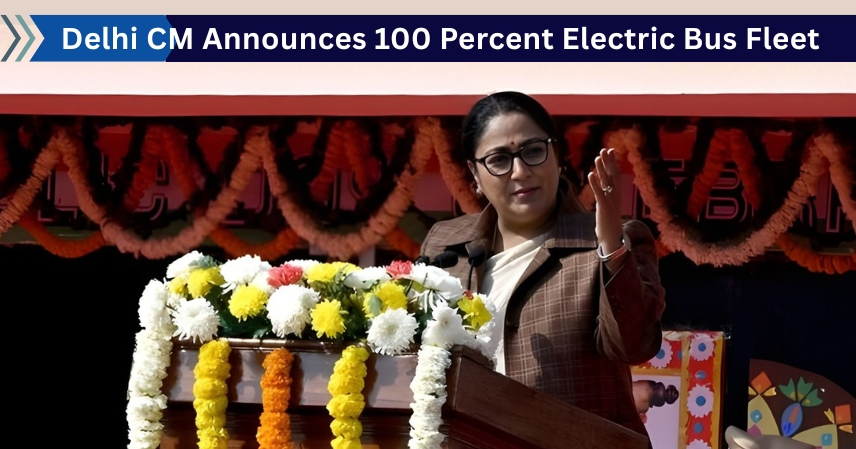
On Republic Day 2025, Delhi Chief Minister Rekha Gupta unveiled an ambitious initiative: within the next three years, all public transport buses in Delhi will transition to electric vehicles. This announcement marks one of India’s most significant urban e-mobility proposals to date.
The Vision: Fully Electrifying Delhi’s Public Transit
Speaking at Chhatrasal Stadium, CM Rekha Gupta outlined the Delhi government’s vision for public welfare, green infrastructure, and healthcare reform. She proudly raised the national flag and declared that the government has approved the induction of 11,000 electric buses into Delhi’s public transport fleet. This will make Delhi the first megacity in India to fully electrify its public bus system.
Rapid Expansion of Charging Infrastructure
To support this transformation, the Delhi administration is rapidly expanding essential infrastructure, including:
- New charging stations for electric buses
- Dedicated electric bus depots
- Enhanced power supply systems
- Advanced maintenance facilities for electric fleets
CM Rekha Gupta emphasized the importance of swift infrastructure development to ensure optimal performance and high uptime for the new electric buses.
Doubling Down: Investment in Green Transport
The government has doubled its capital expenditure to ₹30,000 crore, underscoring its commitment to sustainable transport and urban infrastructure. This additional investment will:
- Modernize Delhi’s transportation network
- Reduce operational costs
- Lower air and noise pollution
Why Delhi Needs Electric Buses
Delhi has long struggled with air pollution and traffic congestion. Electrifying the bus fleet brings numerous benefits:
- Zero tailpipe emissions
- Significant reduction in city air pollution
- Quieter streets
- Reduced reliance on imported fuel
- Lower maintenance and operational costs
- Enhanced passenger comfort
This shift also helps India honor its environmental commitments and progress towards net-zero emissions.
Aligning with National Goals
Delhi’s move aligns with India’s broader push for electric mobility under the National Electric Mobility Program. Key elements include:
- Electrification of public transportation
- Support for domestic electric vehicle development
- Expansion of EV charging networks
- Decreasing dependence on fossil fuels
Delhi’s leadership sets a powerful example for other Indian cities and states.
Healthcare Reform: Ayushman Bharat’s Launch in Delhi
CM Rekha Gupta also highlighted healthcare advancements, notably the launch of the Ayushman Bharat scheme in Delhi. So far, 6.5 lakh residents have enrolled, each receiving up to ₹10 lakh in health insurance. This makes Delhi part of the world’s largest government-funded health insurance program.
Embracing Change: Eleven Months of Governance
Reflecting on the government’s first eleven months in office, CM Rekha Gupta acknowledged the challenges of addressing long-standing issues. Guided by the principle of “Sabka Saath Sabka Vikas” (inclusive development), the administration has implemented key reforms to benefit all residents.
Republic Day Speech: Honoring the Nation’s Spirit
During the celebrations, CM Rekha Gupta paid tribute to India’s freedom fighters and reaffirmed her commitment to upholding the Constitution, which has guided the nation for 77 years as a pillar of dignity, justice, and equality.
Economic and Employment Impact
The shift to electric buses is expected to boost the local economy by creating:
- Manufacturing jobs in the EV sector
- Infrastructure and charging station roles
- Maintenance and EV repair opportunities
- Fleet management and software services positions
This strengthens Delhi’s role in India’s burgeoning green economy.
Expert Opinions: The Promise of Electric Public Transit
Industry experts believe that a fully electric public transportation system can:
- Cut transportation emissions by over 40%
- Reduce operational costs for transit authorities
- Improve reliability and service quality
- Encourage broader adoption of electric vehicles
Delhi’s scale and ambition make it a model for urban e-mobility in India.
Delhi’s Green Transport Policy in Action
Delhi’s policy on electric vehicles is driving the installation of charging stations and the adoption of clean, efficient buses, reinforcing its commitment to green transportation and a healthier urban environment.
Conclusion
Chief Minister Rekha Gupta’s pledge to electrify Delhi’s public bus system within three years is a transformative step. With massive investment, fast-tracked infrastructure, and a forward-thinking policy framework, Delhi is leading the way in sustainable urban mobility. The addition of 11,000 electric buses and expanded charging networks not only modernizes transportation but also sets a benchmark for other cities striving for clean air and improved public health.
FAQs
Delhi aims to electrify all public transport buses by 2028.
The city plans to deploy 11,000 electric buses within three years.
Yes, the government is rapidly installing new charging stations and depots.
Delhi has increased its capital spending to ₹30,000 crore.
Electric buses produce no tailpipe emissions, substantially lowering air and noise pollution.