
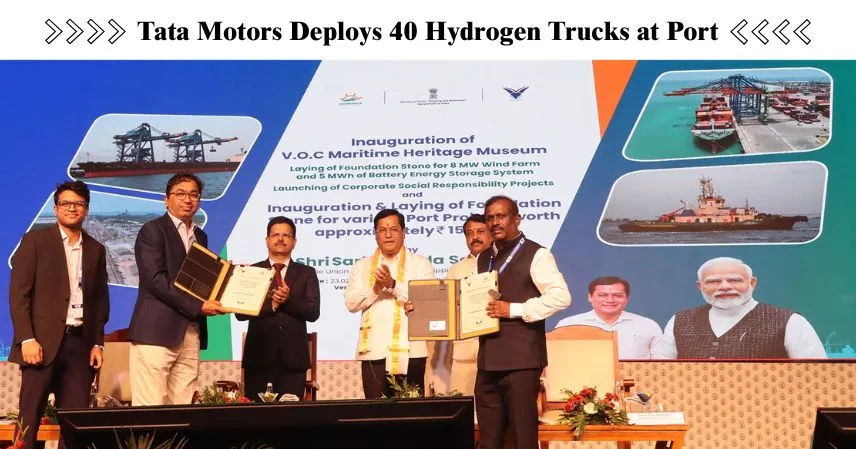
Tata Motors has entered into a significant partnership with V.O. Chidambaranar Port Authority to deploy 40 hydrogen-powered H2 ICE prime movers at Tuticorin Port, Tamil Nadu. This initiative, witnessed by Sarbananda Sonowal, the Union Minister of Ports, Shipping, and Waterways, marks one of India’s largest hydrogen truck deployments for port operations. The project is a milestone in India’s journey toward sustainable, low-carbon cargo transport and aligns with the broader goal of leveraging green hydrogen for cleaner logistics.
Project Overview
Key Details
- Deployment: 40 hydrogen-powered internal combustion engine (ICE) prime movers.
- Timeline: Phased rollout over two years.
- Testing: Initial test runs before full-scale deployment.
- Funding: Fully financed by the Ministry of Ports, Shipping, and Waterways.
- Infrastructure: On-site hydrogen generation and refueling.
Why Hydrogen ICE Trucks for Port Operations?
Meeting the Demands of Heavy-Duty Logistics
Port logistics require:
- High torque for moving heavy loads.
- Continuous operations.
- Ability to handle long idle periods.
- High fuel consumption.
Hydrogen ICE trucks are well-suited for these needs. They use pure hydrogen fuel in a conventional engine, offering a scalable and efficient alternative to battery-electric vehicles, especially in confined port spaces where set routes are common. Hydrogen-powered trucks reduce pollution while maintaining operational speed and efficiency.
The Tata Prima 55 Platform: The Backbone of the Project
Why Choose the Tata Prima 55?
- High payload capacity
- Fuel efficiency
- Long-distance durability
- Driver comfort
The hydrogen-powered version of the Tata Prima 55 maintains these strengths while integrating hydrogen ICE technology for cleaner operations. Key features include:
- Ergonomic, high-end cabin
- Advanced safety features
- Fatigue-reducing design
- Enhanced stability when transporting heavy cargo
This makes it ideal for container and cargo movement within Tuticorin Port.
Hydrogen Infrastructure at Tuticorin Port
Building a Green Hydrogen Ecosystem
The port authority is establishing:
- A 2 MW electrolyzer unit for on-site hydrogen production using renewable energy.
- Dedicated hydrogen refueling station within the port.
This infrastructure ensures seamless operations for the 40 H₂ ICE prime movers and positions Tuticorin as a model for green hydrogen mobility in Indian ports.
Government Support and Policy Alignment
The Ministry of Ports, Shipping, and Waterways is financing the project, demonstrating strong government backing for green hydrogen initiatives. This deployment supports:
- The National Green Hydrogen Mission
- India’s net-zero carbon ambitions
- Decarbonization of shipping and logistics sectors
Tata Motors’ Commitment to Clean Mobility
Tata Motors is expanding its portfolio of alternative fuel vehicles, including:
- Battery electric commercial vehicles
- CNG and LNG-powered trucks and buses
- Hydrogen ICE trucks
- Hydrogen fuel cell electric vehicles
The company has been testing hydrogen trucks along major freight corridors since 2025 and plans to introduce hydrogen fuel cell buses as well.
Hydrogen ICE vs. Fuel Cell Technology
Two Approaches to Hydrogen Mobility
- Hydrogen ICE:
- Uses a combustion engine adapted for hydrogen.
- Lower initial cost and easier integration with existing platforms.
- Well-suited for heavy-duty applications.
- Fuel Cell Electric Vehicles:
- Convert hydrogen into electricity.
- Zero tailpipe emissions and higher efficiency.
- More complex and costlier system.
Hydrogen ICE technology is a practical transitional solution for port operations while fuel cell technology continues to mature.
Impact on Sustainable Logistics in India
Environmental and Operational Benefits
Deploying 40 hydrogen trucks at Tuticorin Port will:
- Reduce diesel consumption
- Lower carbon emissions
- Improve air quality in port areas
- Advance green shipping initiatives
This project sets a precedent that can be replicated at other major Indian ports, strengthening the nation’s green hydrogen ecosystem.
Economic and Industrial Significance
Driving Innovation and Growth
This project not only benefits the environment but also:
- Spurs domestic hydrogen technology development
- Fosters innovation in commercial vehicles
- Enhances advanced manufacturing capabilities
- Opens up export opportunities
- Generates jobs in the clean mobility sector
India aims to emerge as a global leader in green hydrogen production and deployment, and projects like this accelerate industrial growth.
Challenges and Future Prospects
Overcoming Hurdles
Key challenges include:
- High initial infrastructure costs
- Scaling up hydrogen production
- Ensuring safety and storage standards
- Competing with other technologies on cost
With ongoing government, industry, and technology collaboration, hydrogen-powered heavy-duty trucks could become mainstream within a decade, with the Tuticorin model expanding to other ports and logistics corridors.
Expert Insights: The Importance of This Initiative
From a business and industry perspective, this project:
- Demonstrates real-world deployment of hydrogen trucks and buses
- Highlights strong public-private partnerships
- Reflects comprehensive infrastructure planning
- Reinforces the commitment to sustainable transport
It cements Tata Motors’ role as a leader in alternative fuel commercial vehicles and showcases India’s progress in decarbonizing logistics.
Conclusion
The agreement between Tata Motors and V.O. Chidambaranar Port Authority is a landmark step toward cleaner transportation in India. With 40 hydrogen-powered H₂ ICE prime movers, a 2 MW electrolyzer, dedicated refueling facilities, and robust government support, this project sets a new benchmark for sustainable port logistics. As India accelerates its green hydrogen mission, such initiatives place the nation at the forefront of clean, heavy-duty transportation innovation.
FAQs
To reduce carbon emissions and promote environmentally friendly cargo transport.
A total of 40 hydrogen-powered H2 ICE prime movers over two years.
A dedicated hydrogen refueling station and a 2 MW electrolyzer.
The Tata Prima 55-tonne prime mover platform.
The Ministry of Ports, Shipping, and Waterways.