
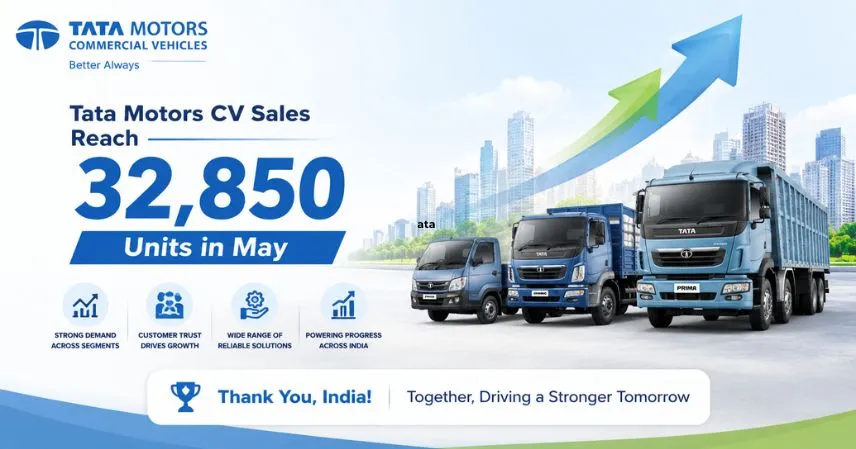
Tata Motors, India’s largest commercial vehicle manufacturer, experienced robust growth in May 2026, continuing its upward momentum. The company sold 32,850 commercial vehicles, marking a 17% increase compared to 28,147 units sold in May 2025.
Key Sales Highlights
- Total CV Sales (May 2026): 32,850 units (+17% YoY)
- Domestic Sales: 30,784 units (+19% YoY)
- Export Sales: 2,066 units (-9% YoY)
Segment-Wise Performance
Heavy Commercial Vehicles (HCV)
- Sales: 7,877 units (up from 7,106 in May 2025)
- Growth: 11%
- Drivers: Construction, mining, and heavy freight transit, supported by government investment in infrastructure.
Intermediate & Light Commercial Vehicles (ILMCV)
- Sales: 5,331 units (up from 4,954)
- Growth: 8%
- Drivers: Increased freight flows between cities, regional distribution, and rising FMCG and industrial activities.
Passenger Carriers
- Sales: 5,757 units (up from 4,748)
- Growth: 21%
- Drivers: Higher demand for school buses, personnel/tourist shuttles, and public transport buses.
Small Commercial Vehicles (SCV) & Pick-Ups
- Sales: 11,819 units (up from 9,064)
- Growth: 30% (fastest-growing segment)
- Drivers: E-commerce growth, last-mile delivery, SME logistics, and urban freight transport demand.
Domestic Market: The Main Growth Engine
- Domestic CV Sales: 30,784 units (from 25,872 units in May 2025)
- Growth Rate: 19%
- Key Sectors Supporting Growth:
- Logistics and fleet owners
- Infrastructure and urban development projects
- Last-mile delivery and e-commerce expansion
- Passenger transport services
Export Performance: A Decline Amid Global Challenges
- CV Exports (May 2026): 2,066 units (from 2,275 units in May 2025)
- Export Decline: 9% YoY
- Reasons for Decline:
- Global economic uncertainty
- Foreign exchange fluctuations
- Cooling regional markets and intense international competition
Market Drivers & Outlook
Tata Motors benefited from strong macroeconomic trends in India:
- Infrastructure development: Increased investment in roads, highways, and industrial corridors.
- Logistics industry expansion: Growth in organized logistics and storage, driven by e-commerce.
- Industrial output: Higher freight movement due to increased industrial activity.
- Urban mobility: Continued demand for buses and coaches for city transport.
The SCV segment remains the most critical growth driver, especially with the rise of e-commerce and last-mile delivery needs.
Tata Motors’ Strategic Position
- Long-standing presence: Decades of experience in commercial vehicle manufacturing.
- Wide service network: Strong relationships with fleet owners and logistics companies.
- Diverse portfolio: Leadership in HCV, ILMCV, SCV, and passenger carrier categories.
- Growth opportunities: E-commerce development, fleet modernization, infrastructure investment, and electrification of vehicles.
Conclusion
- Tata Motors’ commercial vehicle sales reached 32,850 units in May 2026, up 17% YoY.
- Domestic demand drove growth, with notable expansion in SCV, HCV, ILMCV, and passenger carrier segments.
- Exports declined by 9%, but strong local sales more than compensated.
- With continued investments in infrastructure and the logistics sector, Tata Motors is well-positioned to maintain its leadership in the commercial vehicle market.
FAQs
Q: What was Tata Motors’ CV sales growth rate in May 2026?
A: 17% year-over-year.
Q: Which segment showed the fastest growth?
A: SCV Cargo and Pickup, with 30% growth.
Q: How did exports perform?
A: Exports fell 9% to 2,066 units.
Q: What are the main drivers of growth?
A: Logistics, e-commerce, infrastructure, passenger transport, and last-mile delivery.
Q: Is Tata Motors a leading CV manufacturer in India?
A: Yes, Tata Motors continues to be the top commercial vehicle company in India.