
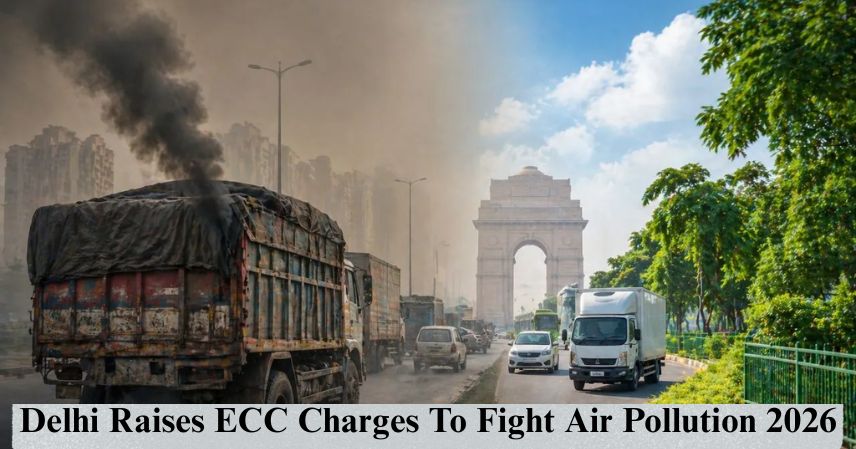
To address the escalating air pollution crisis in Delhi, the government has increased the Environmental Compensation Charge (ECC) on commercial vehicles entering the city. This move targets vehicle emissions—especially from diesel trucks—which are major contributors to Delhi’s poor air quality. The Supreme Court of India has authorized the new ECC rates to discourage unnecessary entry of polluting vehicles and to promote greener mobility options. This marks a significant policy reform aimed at boosting air quality and advancing sustainable transportation in the capital.
What is the Environmental Compensation Charge (ECC)?
The Environmental Compensation Charge (ECC) is a fee imposed on commercial vehicles entering Delhi to offset the environmental damage caused by their emissions. Its key objectives are:
- Reducing vehicle emissions
- Discouraging unnecessary truck traffic
- Promoting cleaner transportation options
The Mission of ECC
- Cut down on car emissions
- Discourage needless truck traffic
- Encourage cleaner mobility solutions
Measures to Support Better Air Quality
Delhi’s government has implemented ECC since 2015, with periodic updates to maintain its effectiveness. The ECC is part of a broader suite of measures to:
- Promote public transport and electric vehicles
- Restore the deterrence effect to reduce vehicular emissions
Delhi ECC 2026: Launch and Approval
The new ECC structure was formally implemented in 2026, based on recommendations from the air quality control panel and with approval from the Supreme Court of India.
Key Policy Highlights
- All commercial vehicle categories will see an ECC increase.
- A 5% annual rise in ECC is scheduled every April.
- The Supreme Court has approved the revised structure.
- 2026 marks the first ECC rate hike in nearly a decade—a major step forward.
Updated Commercial Vehicle ECC Rates for 2026
ECC Tariff Changes
- Light-Duty & 2-Axle Trucks
- Earlier: Rs 1,400
- New: Rs 2,000
- Heavy & Three-Axle Trucks
- Earlier: Rs 2,600
- New: Rs 4,000
Vehicle Categories
- Category 2 & 3: Light-duty and two-axle trucks
- Category 4 & 5: Three- and multi-axle vehicles
These significant increases are designed to be a stronger deterrent against unnecessary entries by polluting vehicles.
The 5% Annual Increase Rule
A notable feature of the new policy is the automatic annual 5% increase in ECC rates, effective every April. This helps:
- Maintain the real value of ECC against inflation
- Ensure the policy remains effective long-term
- Make the ECC escalation a dynamic, ongoing process
Why the ECC Has Increased: Key Reasons
Several environmental and economic factors have driven the ECC rate hike:
- Rising Air Pollution: Persistent issues, especially in winter.
- Diesel Vehicle Emissions: Diesel trucks are major contributors.
- Devaluation of Old ECC: Past rates have lost impact over time.
- Need for Greater Deterrence: Higher fees discourage unnecessary vehicle entry.
- Support for Cleaner Mobility: Encourages a shift to electric and CNG vehicles.
Legal Backing: Supreme Court’s Role
The Supreme Court of India has played a crucial role in:
- Approving the new ECC framework
- Validating the annual escalation clause
- Supporting actions to cut vehicular pollution
This legal support underpins the effective implementation of Delhi’s ECC policy.
Government’s Position on the ECC Increase
Delhi’s Environment Minister, Manjinder Singh Sirsa, has emphasized that:
- ECC is not a revenue-generating tool but a pollution deterrent
- The primary focus is reducing emissions
- The government aims to reconcile economic growth with environmental responsibility
Impact on Fleet Operators and Transporters
Challenges
- Increased operating expenses
- Higher logistics costs
- Pressure on fleet operators’ slim margins
Opportunities
- Push towards cleaner fuel vehicles
- Improved routing and expressway use
- More efficient logistics operations
The ECC hike could revolutionize transport operations and logistics patterns in and around Delhi.
Authorities recommend:
- Using side expressways
- Limiting city access to essential vehicles only
- Improving fuel and cost efficiency
These measures follow Supreme Court directives to reduce non-essential vehicular traffic in Delhi.
Impact on Logistics and Supply Chain Industry
Positive Influences
- Reduced pollution
- Better urban air quality
- Incentives for cleaner vehicle fleets
Disadvantages
- Higher shipping and delivery costs
- Operational changes for logistics businesses
Although companies may face short-term cost pressures, the strategy is designed for long-term sustainability and improved urban environments.
Comparison with Other Cities
Delhi is not alone in tightening commercial vehicle regulations. For example:
- Bhubaneswar: Restrictions on big vehicles during peak hours to control pollution
Such measures represent a growing trend in Indian urban transit regulation.
Industry Trends and Developments
Despite stricter regulations, the commercial vehicle market remains robust:
- Tata Motors: 34,833 vehicles sold in April 2026, up 28% YoY.
- Ashok Leyland: M&HCV sales up 15% with 7,007 units.
This signals strong industry demand despite environmental reforms.
The Future of Delhi’s Entry and Congestion Charge Policy
Trends to watch:
- Greater adoption of electric commercial vehicles
- Stricter emissions standards
- Introduction of low-emission zones
- Smart traffic and pollution monitoring
The ECC policy is set to be a key driver of urban mobility in India.
Conclusion
The rise in ECC for commercial vehicles in Delhi in 2026 is a proactive step toward sustainable mobility and reducing air pollution. With higher charges and an annual escalation, the government aims to promote greener transportation and ensure the policy’s long-term effectiveness. While transporters may face higher costs, the overarching goal is to foster a healthier urban environment and a more efficient logistics ecosystem—leading to cleaner air and less congestion for all.
FAQs
Q1.What is ECC in Delhi?
Ans.ECC is a levy imposed on commercial vehicles entering Delhi to control pollution.
Q2.What are the new ECC rates for 2026?
Ans.Light trucks: ₹2,000; Large trucks: ₹4,000.
Q3.How much will ECC increase each year?
Ans.ECC will increase by 5% annually from April.
Q3.Why did Delhi increase ECC charges?
Ans.To reduce air pollution and restrict polluting vehicles from entering the city.
Q4.Who authorized the ECC?
Ans.The Supreme Court of India approved the revised tariffs.
Q5.Does the ECC lock transporters?
Ans.It increases costs but encourages greener, more efficient transport solutions.